Rugby league can look chaotic at first: players charge into contact, the referee counts tackles, and a kick suddenly changes possession. Once you understand a few rugby league rules, the action becomes easier to follow. The biggest clue is that league is not rugby union. It has 13 players per side, a six-tackle limit and a quick play-the-ball after most tackles. Those differences shape every attacking decision.
How a Rugby League Match Works
A standard senior match has two 40-minute halves. Each team tries to carry or kick the ball towards the opposition’s in-goal area and score points. Players can run, pass sideways or backwards, or kick forwards. Throwing a forward pass is illegal.
The team in possession attacks in phases called sets. Rather than fighting over the ball after every completed tackle, as in rugby union, the tackled team usually keeps possession and restarts immediately. Learning the rugby league basics means recognising when possession ends.
The Six Tackle Rule: Why Teams Keep Kicking
Under the six tackle rule, the attacking team normally gets six tackles to advance. The referee counts them as players are held or brought to ground. After tackles one through five, possession continues through a play-the-ball. If the ball carrier is tackled for a sixth time, the opposition receives a handover and begins its own set.
That explains why teams frequently kick on the fifth tackle. A high kick may give teammates a chance to compete; a low grubber can threaten the try line; a long kick can force opponents to start deep in their territory. Kicking is a choice, not a requirement, and a side can score before tackle six.
A Simple Set-of-Six Example
Imagine a team starts 60 metres from the opposition try line. Three carries gain 25 metres, a pass creates another gain on tackle four, and the playmaker kicks on tackle five. Even if the defending fullback catches it, the kick may leave that team pinned near its line. On television, watch for the referee’s raised arm signalling the last tackle: expect a kick or a risky attacking play.
What Happens at the Play-the-Ball?
The play the ball is the restart that keeps league moving. Once the tackle is complete, defenders must release the carrier. The tackled player gets to their feet, faces the opposing goal line, puts the ball on the ground and makes a genuine attempt to play it backwards with the foot. A teammate, often called the dummy-half, collects it.
Defenders normally retreat ten metres, apart from the permitted marker position. This gives the attack space but also creates offside decisions: defenders who advance too early can be penalised. Holding down the tackled player or interfering with a clean restart is an offence. Sometimes a defensive infringement earns the attack a fresh set, known as ‘six again’; its application varies by competition and field position.
How Points Are Scored
A try is worth four points and requires the attacking player to ground the ball correctly in the opposition’s in-goal area. The scoring team then attempts a conversion kick worth two points. The kick is taken from a position in line with where the try was scored, making wide tries harder to convert.
A successful penalty goal is worth two points. A drop goal during general play is ordinarily worth one point under international laws, although competitions can have special scoring provisions. A converted try therefore produces six points. A rugby league scoring guide can explain why teams sometimes choose a penalty goal instead of attacking the try line.
Forward Passes, Knock-Ons and Other Mistakes
A forward pass occurs when someone throws the ball towards the opposition’s dead-ball line. A knock-on usually occurs when the ball is mishandled forwards off the hand or arm. Both can result in the opposition gaining possession through a scrum or another competition-authorised restart. Passing backwards is legal even if the runner is moving forwards quickly.
Other offences include offside positioning, obstruction, dangerous contact, illegal ball stealing and preventing a quick play-the-ball. Not every lost ball is a knock-on; its direction and the circumstances matter. The referee’s signal helps distinguish a handling error from a penalty.
Scrums, Touch and Restarts
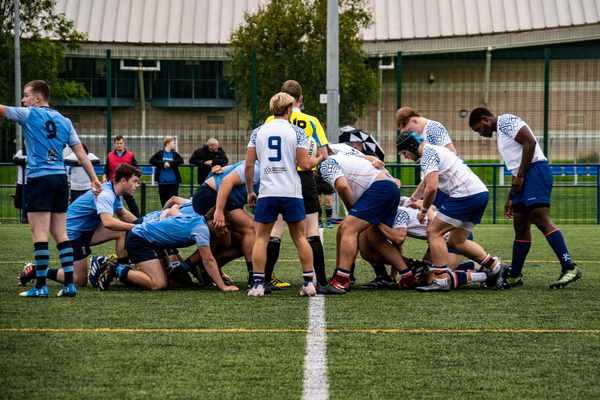
Rugby league scrums are smaller and generally less contested than rugby union scrums. Six forwards from each side bind together, with a scrum-half putting the ball in. They are used for specified stoppages, including certain accidental infringements, not after every tackle.
Restarts deserve attention because league match rules differ between competitions. Under the 2026 international laws, an ordinary ball going into touch is generally restarted with a play-the-ball, subject to exceptions. A kick into touch under the 40/20 rule can reward the kicking side with an attacking tap restart. Kick-offs, goal-line drop-outs and 20-metre restarts cover other situations. If a decision seems unfamiliar, check that competition’s rules.
Penalties, Substitutions and Player Safety
For a penalty, the non-offending team may gain territory with a kick, restart play or attempt a goal where permitted. Serious or repeated misconduct can lead to a player being sent to the sin bin or dismissed. High tackles and dangerous techniques are prohibited: contact is controlled by safety laws.
Teams rotate players from the bench. Standard 2026 international laws provide for 13 starters, four named replacements and eight interchanges, while particular competitions or match categories can use different conditions. Unlike unlimited substitutions, these changes require strategy, especially when forwards tire late in a match.
Rugby League Versus Rugby Union
To avoid confusing the codes, remember three differences: league has 13 players rather than union’s 15, league attacks have a tackle count, and league normally uses a play-the-ball instead of a contested ruck. Scrums and scoring also differ. A rugby league vs rugby union comparison helps when switching broadcasts, while rugby league positions explained can identify the fullback, halves, hooker and forwards.
Frequently Asked Questions
What happens after six tackles in rugby league?
If the attacking player is tackled on the sixth tackle, possession goes to the opposition. Teams commonly kick before that happens to improve field position or create a scoring chance.
Can you pass forwards in rugby league?
No. Passes must not travel forwards out of the passer’s hands, although players can kick the ball forwards during open play.
Why does the referee call six again?
It signals a fresh tackle count for the attacking side following certain defensive infringements. The detailed triggers depend on the applicable competition rules.
How many points is a try worth?
A try is worth four points. A successful conversion adds two, making a converted try worth six.
Conclusion
Follow the tackle count, then watch how the play-the-ball resets the attack. Those two habits unlock rugby league’s pace and strategy. Once you recognise a handover, a fifth-tackle kick and a defensive penalty, the remaining rules become easier to learn while enjoying a match.